The Outer Harness
Somebody keeps a list of projects that wrap, run, supervise, parallelize or remote-control Claude Code and Codex. It has more than 300 entries. I wrote one of them. At some point you have to look up from your own terminal and count the neighbours, so this is the count, with notes on who does what well and where I think OH fits.
Fair warning: I have a horse in this race. I tried to be kind to the other horses. Most of them are good.
A name for the layer
Birgitta Böckeler gave the layer its name. In her piece on harness engineering at martinfowler.com, the outer harness is everything you put around the vendor's CLI: instructions, skills, hooks, tooling. The phrase "harness engineering" itself caught on in February 2026, when Mitchell Hashimoto and OpenAI both wrote about it.
No analyst firm has drawn a market around this yet, which is a relief. The groups below come from how the products behave.
Cut it by where the state lives
Every product here can show you a list of agents. The interesting question is what happens when you close the laptop lid. That depends on where a session's durable state lives: in a terminal process, in a desktop app, in a daemon on each host, in a vendor's relay or in somebody's sandbox. Sort by that and the market falls into six groups.
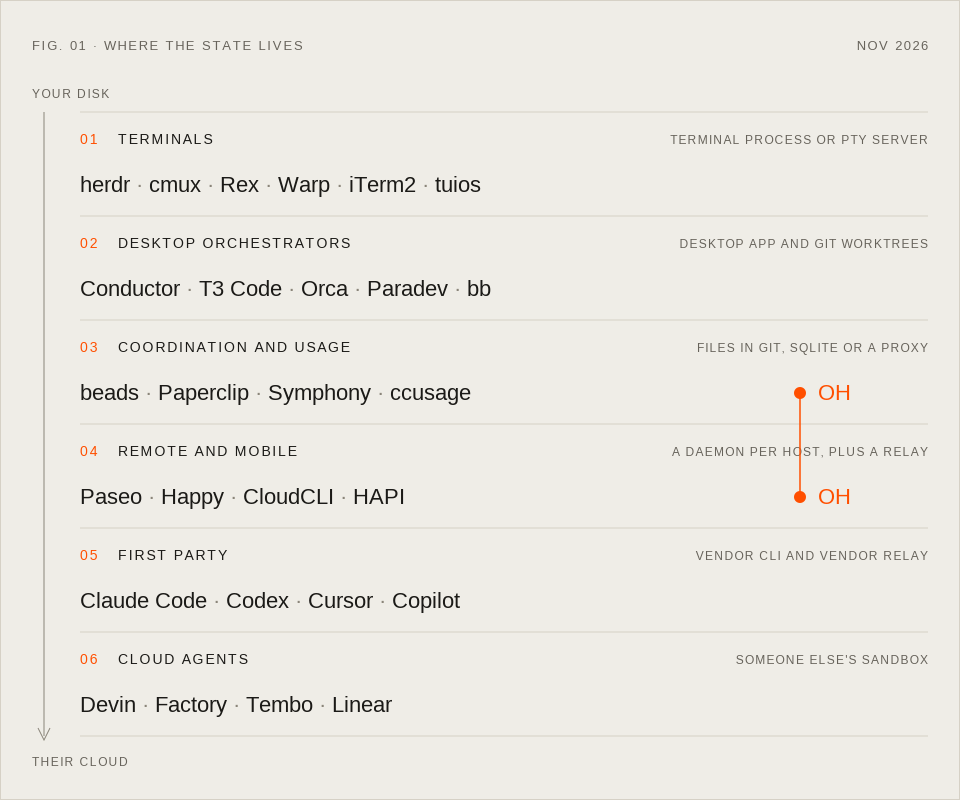
One thing sits under all six. Products learn that an agent is waiting in one of three ways: they scrape the TUI (herdr, Agent of Empires), they listen to vendor hooks and OSC 9, 99 or 777 notifications (cmux, iTerm2, Warp, Emdash), or they read OSC 7501 "Program Status", which Ghostty 1.4 shipped on 27 October and Zellij 0.46 and tuios picked up. Once the terminal emulator can say "this program needs you", the little waiting badge stops being anybody's moat. Including mine.
01 / Terminals
herdr is the breakout. About 52.5k stars, relicensed from AGPL to Apache-2.0, a background runtime whose agent terminals survive a reboot, ssh machines in one window, and agents that can prompt each other. It shipped a native app on 29 October and a mobile client on 9 November. It has no scheduler, and its cross-machine coordinator is listed as "planned". A $6M Bessemer seed has been reported secondhand; I have not seen a primary source.
cmux, from Manaflow (YC, about 28.9k stars), is a libghostty Mac terminal with hook-driven notifications, a built-in browser, cmux ssh, Pro cloud VMs and an iOS app that pairs over its own iroh network. Its Max tier is $200 a month. It does not keep processes alive by itself. Rex, from Hashimoto's new company Superlogical, arrived on 29 July with persistent server sessions, an iOS client and Tailscale reach. Warp open-sourced its client under AGPL in April and sells Oz for cloud orchestration. iTerm2 3.7 wires in Claude Code hooks natively.
The small ones are where my own feature list keeps turning up. mixpeek's amux holds a session at a usage limit and resumes it at reset, runs schedules and reaches hosts over Tailscale. agent-manager keeps accounts apart with CLAUDE_CONFIG_DIR profiles. agent-deck tracks accounts and resumes sessions.
02 / Desktop orchestrators
Conductor defined this group. It raised a $22M Series A in March, claimed more than 100,000 users and was acquired by Meta on 4 November. The Register reported that Conductor Cloud would shut on 20 November. Then the changelog posted "Conductor is back" in 0.94.2 on 13 November and kept shipping: spending controls, usage visibility and, in 0.99 on 23 November, auto-resume for Claude Code and Codex. I could not find a primary statement of what the reversal means for its relationship with Meta, so treat Conductor's status as unclear.
T3 Code (MIT, about 75k stars) runs threads over the agent CLIs on any machine you can reach through Tailscale or T3 Connect, with mobile clients. Orca (Stably, YC, MIT) supports 27 agents and adds a coordinator, an agent CLI with scheduled automations, bots you trigger from Slack and Linear, and usage tracking against Claude, Codex and Grok limits. Its 134.7k-star badge is a strange number and I would not read it as adoption. Superset became Paradev with an $11.5M seed led by USV, added automations and mobile, and charges $20, $60 or $200 a month.
Emdash (YC W26, Apache-2.0) does issue intake and SSH hosts, with a cloud waitlist for 2.0. bb, by Michael Yong, is my favourite oddity: an "agent IDE that builds itself", with a first-class CLI and HTTP API, worktree threads, agents that spawn agents and one server that dispatches to several machines. Imbue open-sourced Sculptor on 18 November, Crystal turned into Nimbalyst, and the IDE companies arrived with Augment Intent and JetBrains Air.
03 / Coordination and usage
These tools hold the work and count the cost, mostly in files, git or SQLite, and leave the running to someone else. beads (about 29k stars) is a git-backed issue graph for agents. Steve Yegge retired Gas Town in favour of Gas City. Paperclip has agents claim tickets on a heartbeat. YC built its own multiplayer harness, qm, and OpenAI published Symphony. Then there is the Ralph loop, which is a while loop with ambitions and works better than it has any right to.
The most-starred utilities in the whole field are usage meters. ccusage and CodexBar read local logs and limits. Langfuse ingests Claude Code traces. claude-swap changes the signed-in Claude account automatically when one hits a rate limit, which tells you something about what heavy users want.
04 / Remote and mobile
Paseo is the most complete independent product in the whole map, and it is one person with no investors. A headless daemon on each host; Electron, iOS, Android, web and CLI clients; a Noise-encrypted optional relay, direct LAN, Tailscale or Cloudflare Tunnel; daemon-to-daemon child agents across connected hosts; schedules, heartbeats and loops; a semantic permission model. It went Apache-2.0 in August. It documents nothing about usage limits or several accounts. If you are shopping for a harness and OH is not your thing, start with Paseo.
Happy (MIT, about 24.8k stars) is the end-to-end encrypted phone companion and is turning toward teams. Omnara launched on HN in February and pivoted on 21 October to an open-source Managed Agents alternative, with the line "We didn't think remote-controlling a local agent was end-game". A lot of people still run Tailscale, tmux and ntfy and call it done, and a Telegram bot has 2.8k stars.
05 / First party
The vendors' own supervisors and relays. They got their own section below, because they changed the most.
06 / Cloud agents
This is where the money went. Cognition raised $2B at a $48B valuation with revenue nearing $900M. Factory went from $1.5B in April to a reported $5B in September. Tembo takes Claude and ChatGPT subscriptions for $60 a month. Linear starts coding sessions through Claude Code or Codex in its cloud, and Coder replaced Tasks with Coder Agents. Caprock is one of the few that pitch running on your own computer. Under all of them sit sandbox vendors such as Modal, E2B, Daytona and Depot.
2026, in order
The year had a shape. Hosted and cloud pieces of independent harnesses died first, local open-source cores hung on, and the big buyers paid for distribution. Vibe Kanban closed its company on 10 April because it "couldn't find a business model that we could get excited about"; the hosted board went and the local workspaces live on as community code. A solo developer's post-mortem on his archived harness put it better than I can: "Claude Code now ships most of what it did", and "the policy is the part that didn't get absorbed".
| Date | What happened |
|---|---|
| 9 Jan | Anthropic blocks OpenCode, Cline and Roo from subscription OAuth |
| 2 Feb | OpenAI launches the Codex app with automations |
| 9 Feb | Terragon shuts down and leaves an open-source snapshot |
| 25 Feb | Anthropic Remote Control ships; Copilot CLI goes GA |
| 30 Mar | Conductor raises a $22M Series A |
| 2 Apr | Cursor 3 ships the Agents Window |
| 4 Apr | Claude subscription limits stop covering third-party harnesses, starting with OpenClaw |
| 10 Apr | Vibe Kanban the company shuts down |
| 28 Apr | Warp open-sources its client |
| 11 May | Claude Code agent view announced |
| 13–14 May | Anthropic reinstates third-party use through a capped programmatic credit from 15 June |
| 14 May | Codex from your phone, through a desktop host |
| 19 May | Gemini CLI becomes Antigravity CLI |
| 11 Jun | OpenAI agrees to acquire Ona, formerly Gitpod |
| 16 Jun | SpaceX agrees to acquire Cursor for $60B in stock |
| 29 Jul | Hashimoto announces Superlogical and Rex |
| 6 Aug | Claude Code self-hosted environments enter public beta for Team and Enterprise |
| 8 Sep | Cognition raises $2B at $48B |
| 29 Sep | OpenAI "Sign in with ChatGPT" brings plan usage to partner apps |
| Oct | Superset renames to Paradev with an $11.5M seed |
| 21 Oct | Omnara pivots away from remote control |
| 27 Oct | Ghostty 1.4 ships OSC 7501 Program Status |
| 4 Nov | Meta acquires Conductor |
| 11 Nov | Google Jules goes read-only and ends on 31 December |
| 18 Nov | Imbue open-sources Sculptor |
| 20 Nov | Conductor Cloud shuts, per The Register |
Codegen went to ClickUp. Further down the list, 1Code, AgentAPI and claude-code-webui are archived, and VibeTunnel, Task Master and CodexMonitor have gone quiet.
The demand is real and narrow. In an Ask HN thread on agentic setups with about 530 commenters, roughly 156 ran two or more agents, 60 described remote or phone access, and 28 named herdr. Practitioners report a ceiling of two or three parallel agents before their own attention runs out. Stack Overflow found that 69% of developers who use agents still run one at a time. This is a market for people with too many machines and not enough hours. I am one of them, and so, I suspect, are you.
What the vendors ship now
Here is the fact every independent harness has to live with: in about eight months Anthropic shipped a local supervisor, needs-input states, phone control, cross-machine messaging and schedules.
Agent view (claude agents) shows sessions as Working, Needs input, Idle, Completed, Failed or Stopped under a supervisor process, with a --json listing. Sessions stop on reboot. Remote Control relays sessions to phone and web, has a server mode that spawns worktree sessions (32 by default) and pushes a notification when an action is required. It needs subscription sign-in, so no API keys, Bedrock or Vertex, and traffic goes over TLS through Anthropic rather than end to end. Cross-session messaging gives Claude agents ListAgents and SendMessage, including to sessions on other machines through Remote Control. Routines run schedules in Anthropic's cloud, agent teams are experimental, the desktop app adds SSH sessions and Dispatch, and Projects has a "Waiting on you" overview. That is a very good product. If you only use Claude and only use one account, it may be all you need.
OpenAI went broader and more desktop-bound. The Codex app has automations with a review queue, but scheduled tasks are not in the CLI, and phone control needs the ChatGPT desktop app on a Mac or Windows host, so no Linux box. The CLI is catching up with codex exec --remote and /rc in 0.171 and 0.172, and app-server speaks JSON-RPC to integrators. Strategically OpenAI did the opposite of Anthropic: "Sign in with ChatGPT" lets Plus and Pro users spend plan allowance inside named partner apps, including Conductor, Warp, T3 Code, OpenCode and Pi, with weekly caps per app. ChatGPT and Codex will share one usage limit from December.
Cursor 3 has the Agents Window, iOS remote control and self-hosted cloud agents, and now belongs to SpaceX, with Grok in the pricing. GitHub's Agent HQ runs Claude and Codex as agents behind Copilot Pro+, and the Copilot app and CLI add remote control. Google's Antigravity has agy remote-control start as a headless daemon and serves Claude models. Zed and VS Code run parallel agent sessions in the editor, and ACP is turning into the seam between editors and agents.
Every one of these stops at its own vendor's agent and, for remote reach, its own vendor's relay. Anthropic's supervisor will not show you a Codex session. OpenAI's remote will not reach a headless Linux box. GitHub's cross-vendor inbox costs Copilot Pro+ and lives in GitHub's cloud. That boundary is the only ground an independent harness can still stand on.
Side by side
Every product in this table can mark a session that needs you, so I dropped that column. "Partial" means the capability exists with a real limit, described above.
| Product | Keeps running without a window | Usage limit as a state | Headless Linux host | How you reach it | Recurring work | Agents talk to agents |
|---|---|---|---|---|---|---|
| OH | Yes, a holder per session | Yes | Yes, through OH Router | Cloudflare tunnel; iroh in the next build | Recurring tasks on a Mac | Yes, Claude Code and Codex, across paired machines |
| Claude Code agent view and Remote Control | Until reboot | No | Yes | Anthropic relay, subscription sign-in only | Cloud routines | Claude only |
| Codex app and remote | While the desktop app runs | No | No, Mac or Windows host | OpenAI relay | In the app | No |
| Cursor 3, Agent HQ, Antigravity | In the vendor cloud | No | Partial | Vendor relay | Vendor cloud | Inside the vendor |
| herdr | Yes | No | Yes | ssh | No | Yes |
| cmux | No | No | Through ssh | ssh; iroh to iOS | No | Partial |
| Rex | Yes, server sessions | No | Yes | Tailscale | No | No |
| amux (mixpeek) | Yes, tmux | Hold and resume | Yes | Tailscale | Yes | No |
| Conductor | No | Auto-resume since 0.99 | No | Local | No | No |
| T3 Code | Partial | No | Yes | Tailscale or T3 Connect | No | No |
| Orca | Partial | Tracks usage | Partial | Local | Yes | Yes |
| Paradev | Partial | No | No | Local and mobile | Yes, on Pro | No |
| bb | Yes, server | No | Partial, alpha | Server dispatch | Guides | Yes, spawn |
| Emdash | No | No | Through SSH | SSH | No | No |
| Paseo | Yes, a daemon | No | Yes | Noise relay, LAN, Tailscale, Cloudflare Tunnel | Yes: schedules, heartbeats, loops | Yes, connected hosts |
| Happy | Partial | No | Yes | End-to-end encrypted relay | No | No |
| Tembo | In its cloud | No | No | Vendor cloud | Yes | No |
Where OH fits
OH is a Mac app, and OH Router is the open-source supervisor underneath it that also runs on Linux. The Router starts Claude Code and Codex in detached terminals that keep running when the window closes and when the Router itself restarts. It reads each terminal as a screen and types a queued prompt only when the agent is sitting at an empty input box, never into a permission dialog or a usage-limit dialog. Sessions that wait on a permission, a question, a usage limit or a failure land in one list, and permission prompts arrive in Notification Center with Approve and Deny.
OH launches the official, unmodified Claude Code and Codex CLIs, signed in by you on your own machines, and it never handles or stores your tokens. A profile is a separate account you own, signed in through its own Chrome profile, and OH shows each one's five-hour and seven-day capacity.
That puts OH with most of this map. The tools that lost subscription access this year (OpenCode, Cline, Roo) reused a subscription's sign-in token to call the model themselves. Conductor, T3 Code, herdr and Paseo run the vendor's own CLI and leave the token alone, as OH does. That's the ordinary use the plans are sold for. Carrying on at a limit is common too. Conductor resumes on the same account when the window reopens. bb, Gas Town and Paperclip can move work to another account if you turn it on, and cmux's CodeRouter does it on Manaflow's servers with the team's stored tokens. OH does it on your machine, one config folder per account, and leaves moving a conversation to another account off until you switch it on for a project.
Routers on other machines pair over a Cloudflare tunnel today; a direct iroh route is coming in the next build. Paired machines form a fleet, where an agent can list live agents on the other machines, read their public turns and send one a message with a delivery receipt. A Claude Code session can check on a Codex session on another machine. Recurring tasks run from a Mac with the window closed.
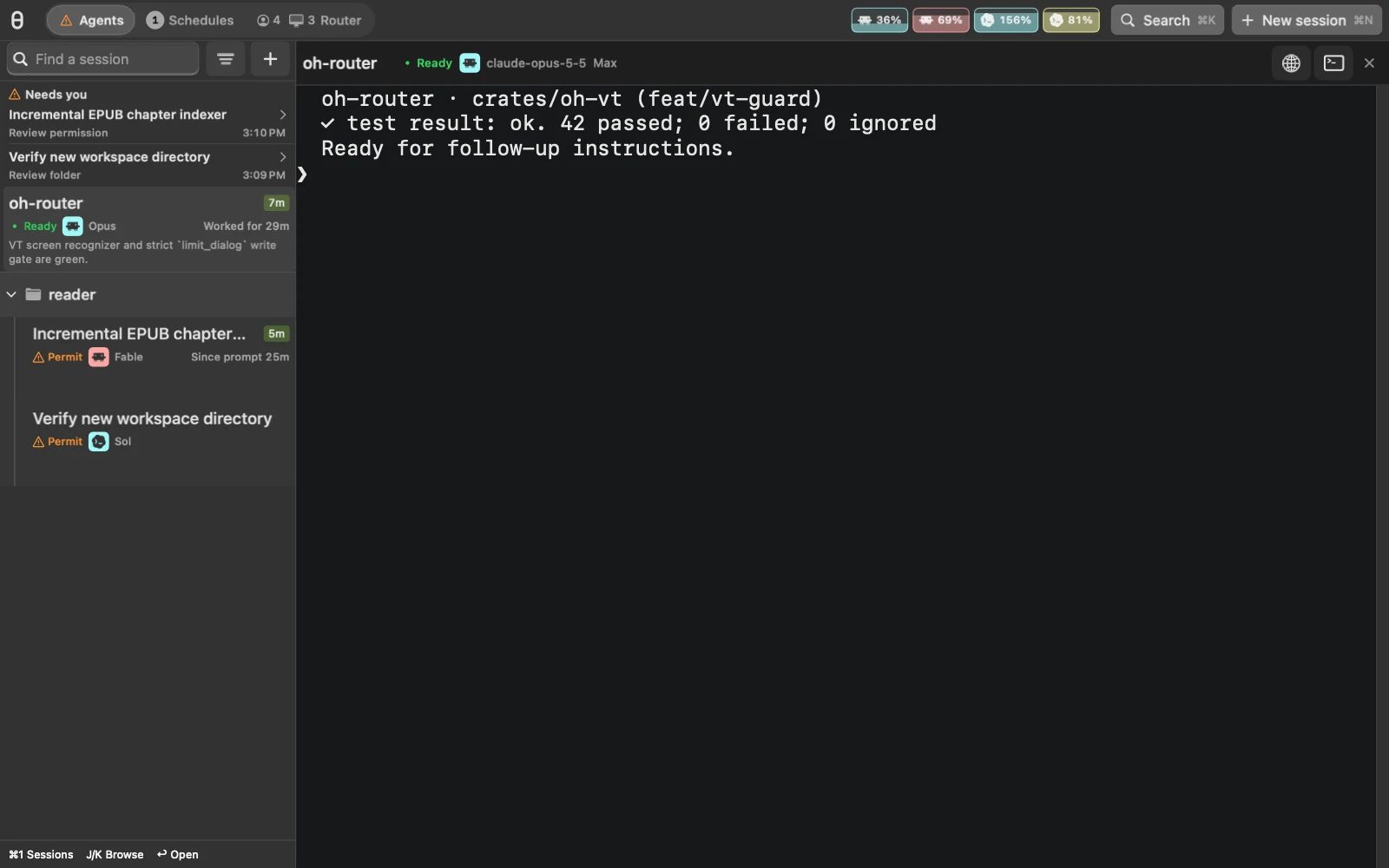
Now the honest part. I did not invent any of these capabilities. Waiting states are table stakes. Background sessions are in Anthropic's supervisor, herdr, Rex and Paseo. Reaching other machines is in Paseo, T3 Code, Rex, herdr and Remote Control, and cmux was using iroh before I was. Agents steering agents exists in herdr, tuios, Paseo, Orca, bb and Anthropic's SendMessage. Recurring work exists in Paseo, Orca, Paradev, amux, Codex automations and Claude routines. On any single axis OH is not special. Paseo matches it on more axes than anything else, and Anthropic's agent view plus Remote Control comes second.
What I could not find anywhere else is the combination. Claude Code and Codex, supervised headlessly on Macs and Linux boxes you already have, over a transport you choose. A usage limit treated as one more reason a session is waiting, next to permissions and questions. Capacity for each of your accounts on screen before you start the work. Agents that list and message each other across both vendors and across machines. No hosted service holding any of it; the only hosted parts are billing, license checks and updates. That last point matters more than it sounds in a year when the hosted parts were the first to die.
The next build also brings the Now and Later names for the two Agents tabs and a way to continue a Codex turn that stopped at a usage limit. A Router-owned queue that spreads Later work across machines is the direction, and it is not built yet.
The threats are easy to name. Paseo adding usage limits and account capacity is a small step for a product that already has schedules and connected hosts. Anthropic making agent view survive a reboot, and opening Remote Control to non-subscription sign-in, would take a large bite out of the Claude half of OH. I would use both.
The long tail
One line each, grouped like the map. Star counts and activity come from GitHub on 24 November. "Quiet" means no push in three months or more. For the full list, see awesome-agent-orchestrators and awesome-cli-coding-agents.
Terminals and TUIs
- claude-squad: a tmux session and worktree per agent; AGPL, 8.9k stars.
- agent-deck: one TUI over many CLIs, with status, resume and accounts.
- amux (mixpeek): tmux fleet, task board, schedules, hold and resume at a usage limit.
- amux (andyrewlee): a minimal worktree-per-agent TUI. Yes, two amuxes.
- agent-manager: account profiles through
CLAUDE_CONFIG_DIR. - tuios: tiling window manager with an inbox across machines and agent messaging.
- Worktrunk: worktrees for parallel agents; Apache-2.0, 12.7k stars.
- workmux: a worktree and a tmux window per branch.
- ntm: a Go control plane across tmux panes.
- tmux-ide: agent-team layouts checked into the repo.
- agterm: native Mac terminal with attention states.
- Calyx: libghostty with an approval inbox and diff review.
- Prowl: a Mac canvas of your agents.
- thurbox: remote SSH sessions with messages between them.
- Tortie: sessions that survive a restart, with an iPhone app.
- Agent of Empires: a TUI plus a web view for phones.
- ccmanager: a session manager across many CLIs.
Desktop apps
- Sculptor: containerized parallel agents from Imbue; MIT since 18 November.
- Nimbalyst: formerly Crystal; visual docs next to code.
- Vibe Kanban: the company shut, the community kept the code.
- opcode: a Claude Code GUI; AGPL, 22.5k stars.
- Xum: Coder's isolated parallel workspace, formerly mux.
- AionUi: "24/7 Cowork" with scheduled tasks; 34k stars.
- Agent Orchestrator: routes CI and review feedback back to the agent.
- Maestro: batch task runs across SSH hosts.
- Parallel Code: side-by-side worktrees with diff and merge.
- supacode: a native Mac worktree command center.
- jean: a headless server that keeps agents alive.
- Berd: Block's desktop, backed by Goose.
- Traycer: spec-driven planning handed to agents.
- Termic: an open-source Conductor alternative.
- Podium ADE: subagents across harnesses.
- ADE: local-first, syncs to web and iPhone.
- Claudette: plan approvals and checkpoints.
- Sidequest PR #56: a daemon and a SwiftUI "needs you" view. The closest architecture to OH I found, still a pull request.
Remote, mobile and chat
- CloudCLI: phone and web UI; AGPL, 14.7k stars.
- HAPI: Happy-style, for many agents.
- Happier: end-to-end encrypted orchestration across machines.
- Omnara: now self-hostable managed agents.
- Zeron: session sync across machines.
- Open Walnut: sessions that survive SSH drops.
- Muxflow: a remote-first tmux IDE with voice reply.
- hexokit: a phone-first tmux console.
- Roamgate: a third-party herdr client.
- Garcon: hand a task from one agent to another, with PR flows.
- openharness: supervision across machines.
- Perch: answer prompts from the Mac notch.
- claude-code-telegram: a Telegram bridge; 2.8k stars.
Cloud, sandboxes and ticket-to-PR
- OpenHands: a self-hostable control center.
- Terragon: gone, with an open-source snapshot left behind.
- Open SWE: LangChain's async agent.
- Cyrus: Claude Code for Linear, Slack and GitHub.
- Optio: ticket to PR on Kubernetes.
- Centaur: Paradigm's Kubernetes sandboxes.
- Scion: Google Cloud's container testbed.
- remote-swe-agents: AWS, a serverless worker per session.
- Sandcastle: a sandboxed agent SDK.
- container-use: a container and a branch per agent.
- Rivet Agents: a durable process per agent.
- claude-code-action, codex-action and run-gemini-cli: each vendor's GitHub Action.
- gh-aw: GitHub Agentic Workflows.
Coordination and loops
- beads: a git-backed issue graph for agents; about 29k stars.
- Paperclip: agents claim tickets on a heartbeat, under budgets.
- Multica: assign issues to agents.
- qm: YC's multiplayer harness.
- Symphony: OpenAI's isolated autonomous runs; quiet.
- Backlog.md: a Markdown task board in git.
- CCPM: GitHub Issues plus worktrees.
- CLI Agent Orchestrator: AWS's supervisor and workers over tmux.
- hcom: agents message and spawn each other.
- AgentBridge: Claude Code and Codex collaborating live.
- codex-plugin-cc: OpenAI's plugin for calling Codex from inside Claude Code.
- oh-my-codex: hooks and teams for Codex.
- Archon: deterministic workflows with gates.
- Bernstein: rules-based coordination with no model in the loop.
- ralph-orchestrator: Ralph, wearing hats.
- Continuous Claude: a PR loop that waits on CI.
Usage, accounts and observability
- ccusage: token and cost reports.
- CodexBar: usage and limits in the menu bar.
- claude-swap: changes the Claude account automatically at a rate limit.
- cc-switch: a provider and account switcher, with a star count I do not believe.
- Claude Code Router: points Claude Code at other models.
- ccstatusline: usage in the status line.
- splitrail: a real-time token tracker.
- Agent Sessions: search and resume across agents.
- Claudescope: a transcript and cost browser.
- codecast: a triage inbox for sessions.
- agi-cli: install and pin many harnesses.
Protocols and editors
- ACP: the editor-to-agent protocol, and claude-agent-acp to put the Claude Agent SDK on it.
- agent-shell: ACP agents in Emacs.
- claudecode.nvim: Claude Code in Neovim.
- claude-code-ide.el: an Emacs integration over MCP.
- avante.nvim: Cursor-style Neovim with ACP.
The question I keep asking
The badge stopped being a differentiator when Ghostty learned to draw it, and every vendor ships a phone view. What is left is a smaller and harder problem. It is Thursday night, one account's weekly limit is nearly spent, and three agents on two machines each have a good reason to spend the rest. Which one gets it, and did you decide that on Monday, or is it about to be decided for you?